Interview: Steve Kilbey of The Church
Steve Kilbey, the multifaceted artist known for his roles as a singer, songwriter, poet, author, and painter, has been a significant figure in the music industry for decades. With over 1000 songs to his name, Kilby has dedicated his life to his craft, focusing almost entirely on music and art.
His band The Church has recorded 27 albums over 45 years. The band’s musical journey has seen them evolve from a psychedelic band to incorporating surreal soundscapes, rock, and drum pop elements. Kilby attributes this transformation to the band’s willingness to let their music naturally evolve, embracing changes and new influences.
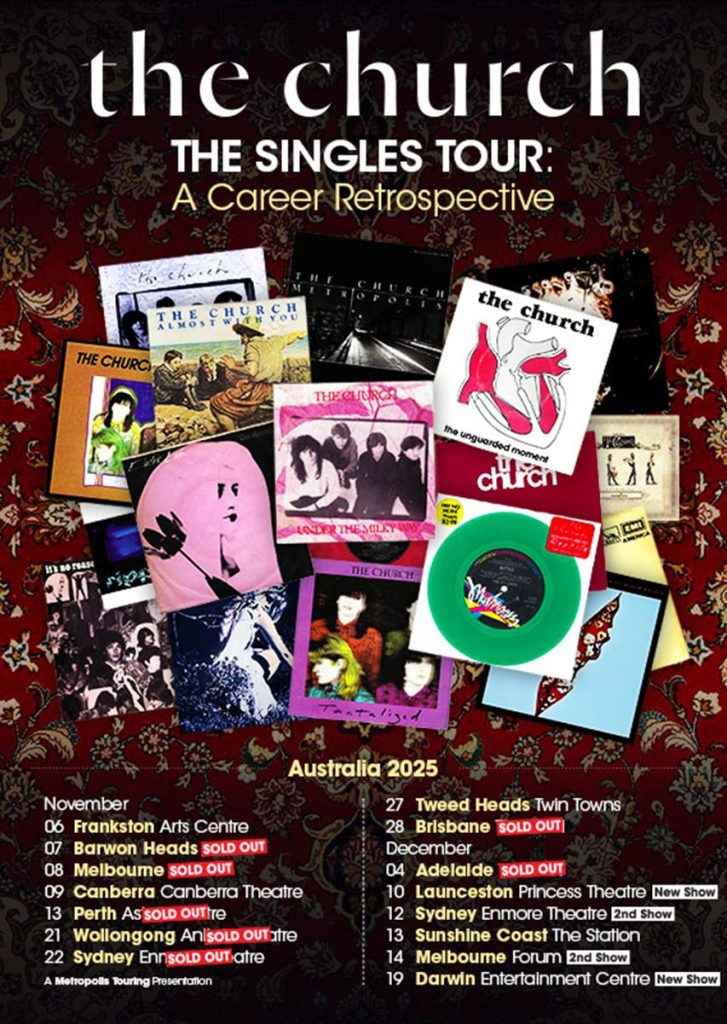
The Church is set to tour Australia in November, performing a unique singles tour that is close to selling out across Australia.
In this interview with Sheldon Ang Media, Kilby shares insights into his creative process, the evolution of his band, The Church, the realities of being a musician and the meaning behind Under the Milky Way.
Watch the full, unedited interview video below.

The poet, painter, author, and singer songwriter
Sheldon: First of all, thank you so much for taking this call. Steve, you are a singer, songwriter, poet, author, and painter. And you’ve registered over 1000 songs. How do you do it?
Steve: Right? Well, I’m pretty old, so I’ve had a lot of time to do all that stuff. I’m not very good at anything except for these matters (the arts). I’d never get a job as a gardener or a carpenter. I wasn’t very good when I was a clerk. So this is all I’ve focused on all my mind onto these kinds of matters.
If you looked at my brain, sort of 98% is for writing music, painting all the things you mentioned and 2% is for doing sensible things. So I’ve become a real specialist. That’s how I do it, by not being very good at anything else.
Sheldon: And the royalties must be huge?
Steve: The royalties I get paid, you think it’s huge? Maybe it’s not bad, but probably not as good as you think. Unfortunately, no, but still it’s something.
Song writing process of Steve Kilbey
Sheldon: So tell us about your songwriting process. Do you let the ideas come to you where you’re being inspired by your surroundings, or do you manifest your storyline, or do you sit at the table and hope that something comes up? Let’s use Under the Milky Way as an example. How do you manifest such lyrics?
Steve: Well, that one was pretty quick. They’re all quick. It all comes quickly. Sometimes, when I write, I usually have the music first – whether I write it on my own, or I write it with the band or write it with somebody else. So somebody comes to me to collaborate that they have the music. And with that, I wrote the music on the piano pretty quickly.
For that song Under the Milky Way, my then-girlfriend and I wrote the lyrics together. The whole thing was over in about ten minutes. And I would say most of the things I write, I write very quickly. If I’m sitting there going, ‘oh’, then I know I’m doing something wrong; it should all be really easy.
It’s like, so playing golf or something…you should be really relaxed and it should be really easy. But, I’ve been writing songs for a long time. I’ve tried all different ways I’ve tried writing the words first and then putting in the music. I’ve tried writing the music first and then putting the words on.
Sometimes they all come together. Sometimes. I’m just jamming with the band and, something with the band the church has been doing lately is writing really long pieces of music, like jamming for like 40 minutes. So you’ve got a 40-minute piece of music, and then you bring some outside person in, like the engineer or the producer, and you say, cut that all up into a song, and then they take that 40 minutes and they condense it all the best bits into a song, into a little piece.
But whatever. I’m open to every single way. I just made an album with a classical guitarist, and he had all the music finished, and I just went into the studio and I’d say the engineer put up the next song, and he put up the next song, and I listened to it, and the lyrics would sort of just appear out of nowhere in my head.
And the melodies are the hardest thing to find, not the music. So I usually try to find the melody and you can do this thing, you know, vocalising where you hear a piece of music going, the dah dah dah. And then eventually it sort of turns to the shapes of the words start to turn into real words. But there are many, many, many different ways to write songs. On piano, on guitar, on a bass guitar. Just walking down the street. Sometimes a whole song could come into your head. So whatever it is, I’m ready for it. I’m waiting for it.
Under the Milky Way
Sheldon: I was reading on the internet that no one knows the meaning behind Under the Milky Way. Is that true?
Steve: It’s open to interpretation. And that’s why it’s such a successful song, I think, because it isn’t about anything. It’s like putting you in a mood and then your imagination will do the work. And that’s why so many people like it and love it. Because it sort of doesn’t tell you (anything specific). It’s not a song that tells you to think about something. It’s a song that goes, ‘here’s a mood that you may enjoy’, and then you get in that mood and then your imagination will do the work for you. And you might remember a lovely starry night. You might remember a lady you once loved. A lot of people who sort of remind them of people who’ve passed away. Or it takes them back to a certain time when they were young or old, you know what I mean? Or for some people, it just gives them a mood. They like a mood. They enjoy being in, like smelling a perfume. It doesn’t mean anything as such. But the perfume puts you in a mood.
I find the very best books and the very best songs and very best films -They don’t tell you exactly what to feel. They just set it all up for you. And it’s like a door and then you open that door and you walk through, and then your mind creates all the rest.
I think that’s one of the Milky Way is such a successful song. It’s because it’s ambiguous.
27 Albums and touring life
Sheldon: Exactly. So The Church have recorded 27 albums over the last 45 years or so. It’s like one album every one and a half years. Do you feel like it’s a full time job being a musician, because people think being a rock musician is all about this hedonistic lifestyle?
Steve: Yeah. It seems to be, as I told you, I was supposed to be here just having a day off and someone went, ‘hey, we’ve got some interviews for you.’ I’m always working. I’ve always been working on music. I will, I’m always working on lyrics. Whatever I do, If I’m reading a book. If I’m having a conversation with someone, if I’m sitting on a bus or train or an airplane, I’m always looking for things I can use. So in that way, it is a full-time job. A lot of things about music surprised me. I thought if I were a musician, I’d get to sleep in every morning. And I find that isn’t true because you often have to be at the airport at 6 a.m., flying somewhere. So, yeah, there’s a lot of stuff people don’t see, We’re about to do an American tour and people come in and go, oh, look at this. You know, The Church come on at 8:00 at night. And they play for two hours, and then it’s all over, but they don’t see all the stuff that came before that, you know, being on the bus and driving there. And then you got to get there and normally all of the stuff’s got to be checked out, and then you’ve got to do the soundcheck.
And now a new thing, Sheldon, that people have these days are the meet and greets. We’re not doing it in Australia on this tour, but when we tour America, we do a meet and greet. So every day there’s an hour and a half put aside, while people pay to meet and greet us. And, so there’s a new thing that when I started, there was none of that. You couldn’t meet and greet people, but nowadays they’ve got that. So it’s a pretty full time. You can get really tired of all the travel and all the, the airports and the taxis and meeting and greeting. But it’s what you do, you know, just what you’ve got to do.
Evolution of The Church
Sheldon: Speaking of those years, 40 years ago, the band started off as a psychedelic band, and then the band moved towards the surreal soundscapes now blending to its elements of rock and drum pop and so on. Is that a deliberate move, or is it because the band have become more mature, or the tastes have changed over 40 years or so?
Steve: I’ve just let it go where it wants to go. That’s always the thing with poetry. I think that’s the thing with writing a book when you start. When I started off, I had some idea of what I wanted the band to be. And then when it started becoming something else. We let it be that, and you see that happening, you see that happening with people, they start drifting into other areas, sometimes successfully, sometimes unsuccessfully.
You start drifting towards prog rock or you might drift towards country music or you might drift towards hard rock, or you might drift towards ambient, and I think that is the thing is to let it go where it wants to go. I think that’s the secret with art, if you start painting a horse, but if the horse turns into a dragon, let it be a dragon. I don’t know. The universe wants to work through musicians and artists, and I think you should listen to what the universe is. Be open, be open to changing and transforming what you do.
Hall of Fame
Sheldon: And so the band was inducted into the Hall of Fame, I think 2011, wasn’t it? Must be quite surreal? I mean, it’s not unexpected.
Steve: Yeah, 2010. Well, it’s better than being inducted into a jail, that’s for sure. Yeah… you know, all that stuf…. I don’t know…it wasn’t the American Rock n Roll Hall of Fame – That really would have been something. But yeah, I’m glad. I’m glad that happened. For sure. That was a good thing. That was a good moment. We had some fun and it didn’t change much. And there is no actual Hall of Fame in Australia either. There’s no actual building, you know what I mean? Not like in America. There is an actual Hall of Fame. In Australia, it’s just a mental Hall of fame. So, but yes, definitely. You know, I enjoy all those things. The sort of honors that you can have bestowed upon you when you win an award or your album is voted the album of the year or whatever it is, but I don’t get too carried away by it, but I certainly appreciate it.
Sheldon: You mentioned the American Hall of Fame. The band is going to America on tour, I think in a few months time which includes New York…
Steve: We’re playing in the Hall of Fame in Cleveland – which is the thing. So it is actually a gig where you can play.
America – Sliding Door – The What If’s
Sheldon: Hah! Yes, and I know you guys had several top 40 hits in America, so how close were you guys in becoming this huge band back in the 80s in America?
Steve: I think we were close. We used to have a manager who used to go, ‘You guys can be bigger than U2’, but it never happened. For various reasons… It’s like, have you heard that saying many are called, but few are chosen? You know, there are 1 million bands start every year, but only a thousand of them will ever get to this level, and then any 500 will get to that level, and eventually only one band will become U2.
And there’ll be many, many bands that never quite got there. And that happened to The Church was so it looked like it was all going to really happen. And then for many, many reasons, it didn’t happen. And that was sad because I can see now, looking back on it, I can see so clearly – The band started arguing, we had some success and we all started arguing with each other.
Our manager wasn’t very good. Our record company didn’t understand us. We’ve worked too hard. In 1988, we did a tour. I think we worked almost every night of the year. You can look back on it and see it on a website. You can look back and see all the gigs we played. And not only that, but we were booked, we were flying around the world and you know, you’d fly to Adelaide for a gig you already had booked and then you’d fly to Copenhagen, and then you fly to America and go around America a bit, and then you go to London and then Brazil.
And it’s just all this flying and traveling and arguing and it all fell through. And our next album, was kind of a weak album, to tell you the truth. The album that was going to be the big one, it didn’t materialize. So we were we fell by the wayside. And then a few years later, grunge came along and that was the end of it.
Grunge kind of replaced whatever the hell it was we were doing. And then you just have to hang in there, and then you hang in there along for a long time, and eventually you come back into fashion again.
The Australian Tour
Sheldon: Yeah, a very interesting story. But having said that, The Church will be touring across Australia in November, and I’m just reading from the press release, the single tour singles tour will be the first ever The Church have played… a show in its unique format, celebrating their rare guitar brilliance and songwriting conventions. Tell us more about this uniqueness, of this upcoming tour in Australia.
Steve: Well, I’m going to tell you the truth. A promoter came to me who’s also a friend of mine, and he said, I want, I want to do a tour. It’s going to be really successful.
I only want you to play your singles. He said, if you do this tour for me, I guarantee you’ll be a success. And I went, okay, now it’s selling out everywhere. I guess that’s what people wanted. Well, not all of our singles are hits, so some of our singles, what you might call deep cuts. It’s not like we’re coming out and going bang, bang, bang, bang, bang and playing hit after hit after hit. There’s only The Church only really had 4 or 5 hits in Australia, so it’s not a bad idea and I’m really happy with how it’s going. Maybe next year it’ll be something else.
But so, so far it’s it’s proving to be a really popular idea. People want to hear those singles, so that’s what we’re giving them.
Sheldon: So it’s the Greatest Hits tour, basically.
Steve: Yep. That’s what that’s what David Bowie did. I mean, if you look at what David Bowie did, most of his tours, he was playing these singles. He would throw in a couple of other ones, but mainly it was all his hit singles. That seems to be what, almost everybody does.
Sheldon: Yeah. Finally. Steve, thank you so much for your time.
Steve: Thank you Sheldon
Tickets On Sale Now From: https://metropolistouring.com/the-church-the-singles-tour-2025/
THE CHURCH November 2025 Australian Tour Dates
Thursday 6th November – FRANKSTON, Performing Arts Centre
Friday 7th November – BARWON HEADS, Barwon Heads Hotel – SOLD OUT
Saturday 8th November – MELBOURNE, Forum – SOLD OUT
Sunday 9th November – CANBERRA, Canberra Theatre
Thursday 13th November – PERTH, Astor Theatre – SOLD OUT
Friday 21st November – WOLLONGONG, Anita’s Theatre – SOLD OUT
Saturday 22nd November – SYDNEY, Enmore Theatre – SOLD OUT
Thursday 27th November – TWEED HEADS, Twin Towns
Friday 28th November – BRISBANE, Tivoli – SOLD OUT
Sunday 30th November – ADELAIDE, The Gov – SOLD OUT
Wednesday 10th December – LAUNCESTON, Princess Theatre – NEW SHOW
Friday 12th December – SYDNEY, Enmore Theatre – NEW SHOW
Saturday 13th December – SUNSHINE COAST, The Station
Sunday 14th December – MELBOURNE, Forum – NEW SHOW
Friday 19th December – DARWIN, Darwin Entertainment Centre – NEW SHOW
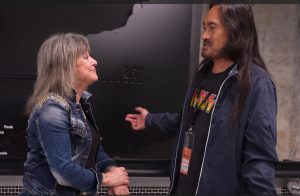
About the Interviewer: Sheldon Ang, photographer, writer and the founder of Perth-based Sheldon Ang Media (est. May 2022) has been accredited to over 200 of the hottest acts including Taylor Swift (ERAS Tour in Sydney), Coldplay (Perth), Backstreet Boys, KISS, Iron Maiden, RHCP and P!NK with reviews shared by the likes of Belinda Carlisle, UB40, Delta Goodrem, The Wiggles and Toni Childs on social media. He has interviewed rockers Suzi Quatro (pictured below), Ian Moss, Ace Frehley (KISS), John Steel (The Animals), Frank Ferrer (Guns N Roses), Phil X (Bon Jovi), Andrew Farris (INXS) plus over 70 artists. He’s also a contributor on Triple M Radio as a music journalist.